

Armenia: Human Rights Challenges for New Leadership
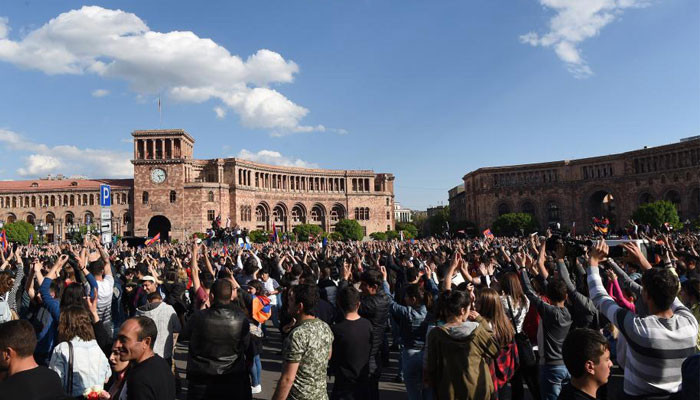
Armenia’s new government has inherited a country plagued with corruption and myriad human rights problems, Human Rights Watch said today in its World Report 2019. As the new leadership embarks on rebuilding the institutions and responding to accumulated public grievances, they should ensure respect for due process and fundamental human rights.Weeks of popular protests in 2018 forced the outgoing president, Serzh Sargsyan, to step down after he tried to hold onto power as prime minister, following the end of his second presidential term. The protest leader, the opposition politician Nikol Pashinyan, became Armenia’s prime minister, but resigned in October to trigger snap parliamentary elections. International observers found that the December parliamentary vote was conducted with “broad public trust,” and was free from abuses that marred past elections, including vote buying and pressure on voters.”
“Ensuring a free and fair vote is an important first step for Armenia’s new leadership,” said Giorgi Gogia, associate Europe and Central Asia director at Human Rights Watch. “But it’s only a beginning. The authorities need to use this mandate to push through reforms to address the human rights problems that brought people to the streets.”
In the 674-page World Report 2019, its 29th edition, Human Rights Watch reviewed human rights practices in more than 100 countries. In his introductory essay, Executive Director Kenneth Roth says that the populists spreading hatred and intolerance in many countries are spawning a resistance. New alliances of rights-respecting governments, often prompted and joined by civic groups and the public, are raising the cost of autocratic excess. Their successes illustrate the possibility of defending human rights – indeed, the responsibility to do so – even in darker times.
Among the grievances Pashinyan’s government inherited is a long record of police impunity for using excessive force to break up largely peaceful protests. The new government made some progress in investigations into abuses that had been stalled for years. It revived an investigation into the March 2008 deadly clashes between protesters and security forces, and authorities brought charges against then-president Robert Kocharyan and two commanders. They also brought charges against a policeman accused of seriously ill-treating four defendants in a court basement.
However, in September, the authorities suspended the investigation into another similar episode in July 2016.
As the authorities deal with past grievances, they should fully respect due process rights for all detainees and ensure independence of the judiciary, Human Rights Watch said.
Other human rights concerns in Armenia include domestic violence; violence and discrimination against lesbian, gay, bisexual, and transgender (LGBT) people; lack of access to quality education for children with disabilities; and institutionalization of people with psychosocial disabilities (mental health conditions) and intellectual disabilities.
During the first five months of 2018, the police recorded 864 incidents of violence against women, including 223 cases of domestic violence. Authorities brought charges against 31 people for domestic violence through July, and courts convicted seven. The authorities approved an action plan in February to carry out the 2017 domestic violence law, but the government needs to increase the number of shelter spaces for domestic violence survivors, establish state-run shelters, and conduct public awareness campaigns about the issue.
The authorities also need to address widespread harassment, discrimination, and violence against lesbian, gay, bisexual, and transgender people. Political parties and some politicians tried to exploit widespread homophobia and made hateful and derogatory comments during the pre-election period.
While Armenia continued to transform some residential institutions for children into community centers and to support family-based care, these programs did not include children with disabilities on an equal basis with other children. Existing legislation allows the government to deprive people with psychosocial or intellectual disabilities of their legal capacity, and there are no supported decision-making systems that would enable people with disabilities to instead get the help they need to live in the community. As a result, some people with disabilities remain in institutions indefinitely.

Оpen letter to diplomatic missions in Аrmenia
9720:30
CENTCOM chief in Saudi Arabia
382Yesterday, 21:54
Canada to provide C$350 million for interceptor missiles for Ukraine
391Yesterday, 18:19
"Trying anything possible to get me out": Trump says no "regret" about starting war with Iran (video)
431Yesterday, 09:19
Katz again threatens ‘powerful response’ if Iran attacks Israel
57710.09.2026, 15:49
U.S. Representative Mike Carey raised the Armenian hostages held in Baku during the House Ways and Means Committee hearing (video)
42510.09.2026, 14:19
Over the past day, the Defense Forces struck eight infrastructure facilities in the Russian Federation, including an oil refinery and a commercial port, Zelenskyy says (video)
54410.09.2026, 12:19
US citizens will receive $5,000 if Republicans win midterms, Trump claims in lengthy convention speech (video)
49010.09.2026, 10:55