

Armenia’s protesters just removed its Russia-friendly prime minister — and Moscow is ‘definitely nervous’
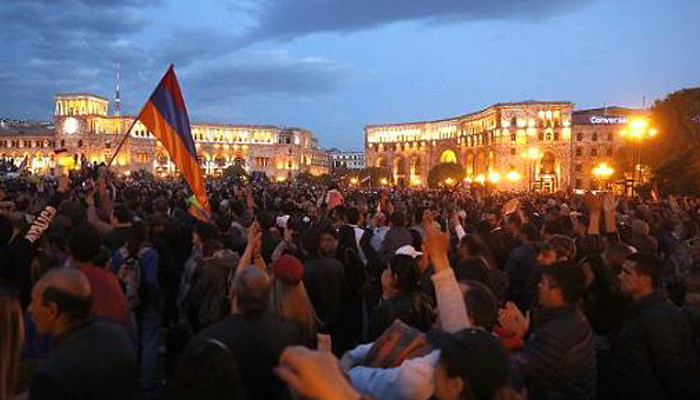
Armenia's prime minister stepped down Monday after nearly two weeks of anti-government protests, in a surprise victory for tens of thousands of peaceful demonstrators.
The ex-Soviet republic of about 3 million, sandwiched in the mountainous Caucasus region between Europe and Asia, relies heavily on Russia, both militarily and economically.
A change in government could threaten Russia's level of influence in the country — meaning the Kremlin will be watching closely as developments unfold.
What happened in Armenia?
Serzh Sargsyan, who served as the country's prime minister for 10 years, is a close ally of Russian President Vladimir Putin and was accused of clinging to power by followers of the protest movement led by opposition leader Nikol Pashinyan.
Constitutional changes made under Sargsyan's government enabled a concentration of power in the hands of the prime minister.
"I got it wrong," Sargsyan said in a statement following the release of Pashinyan, who had been arrested, and nearly 200 detained protesters, most of whom were young people and students. "I am quitting the country's leadership and the post of prime minister of Armenia."
Former Armenian PM Karen Karapetyan, an ally of the ousted leader, has assumed the position for the time being, and the parliament must put forward the name of a new prime minister within seven days.
Sargsyan's allies remain in the government, but the opposition parties are likely to push for greater recognition of the protest movement. This may be a challenge considering they form a tiny minority in parliament — Pashinyan's opposition coalition, the "Way Out", has just nine seats out of 105 in the Armenian National Assembly.
Russia watching closely
Still, any potential changes — particularly one triggered by a grassroots-led popular effort — is anathema to nearby Russia, which considers Armenia strategically important.
"Moscow is definitely nervous, and watching how this plays out with great interest as it sees Armenia as its backyard and within its strategic umbrella," said Timothy Ash, senior emerging markets strategist at Bluebay Asset Management. "Putin also despises so-called colored revolutions where grassroots, people power, grasp power from established authorities."
Armenia is a member of the Moscow-led Eurasian Union, a sort of counter to the European Union (EU), which it joined at the expense of potential memberships in EU partnership projects. It benefits from cheap financing, energy and investment from Russia, and has 5,000 Russian troops defending its borders.
It also relies on Russia as a strategic ally in its long-standing ethnic and territorial dispute with neighbor Azerbaijan over the district of Nagorno Karabakh, which has been the scene of numerous firefights, mortar and tank warfare, with around 200 soldiers and civilians killed since 2008.
While the current acting prime minister is trusted by Moscow, "I think they would be nervous at any scenario which saw the current administration ousted and a completely new government created, e.g. around Pashinyan, whom I don't think they trust," Ash said.

Switzerland’s Parmelin will leave government at year-end
45002.10.2026, 19:00
Trump says Iran will ‘either sign a very fair deal’ or cease to exist (video)
30802.10.2026, 09:24
Trump: If I weren't president, Saudi Arabia wouldn't be here right now. Neither would Israel
58501.10.2026, 16:13
Trump warns war against Iran will end 'very soon, one way or another' (video)
55401.10.2026, 11:54
Transportation Minister Regev demands flydubai flight suspension, probe of UAE aviation agreement
62030.09.2026, 16:36
Move to rejoin EU among options for UK, says Burnham (video)
63130.09.2026, 13:01
Supreme Court lets Trump resume deporting migrants to countries not their own
56430.09.2026, 12:18
Russia warns of nuclear response to any Kaliningrad blockade
55330.09.2026, 11:13