

Coronal mass ejection from colossal New Year's Eve solar flare will strike Earth today
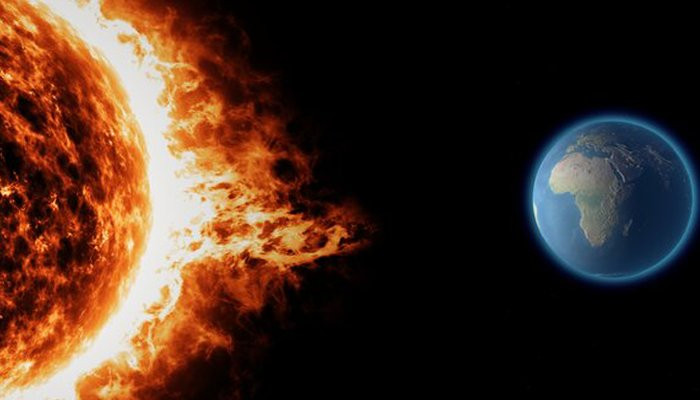
Earth will be struck today by a coronal mass ejection from a huge solar flare that erupted from the sun on New Year's Eve.
The New Year's Eve flare created a CME, a huge bubble of plasma from a region of the sun called the corona, which is equivalent to the sun's outer atmosphere, and this has an Earth-directed component. Though this massive ejection of plasma will only graze the magnetic bubble surrounding our planet Tuesday (Jan. 2), the magnetosphere, it could trigger a geomagnetic storm that could affect communications and power infrastructure.
The coronal mass ejection CME was hurled into space by an X-class solar flare that burst from the surface of the sun at 4:55 p.m. EST (2155 GMT) on Sunday (Dec. 31). It is the most powerful flare that has happened on the sun during the current solar cycle, solar cycle 25, which began in Dec. 2019. In fact, the flare that ended 2023 with a bang is the largest that has been observed since Sept. 10, 2017, according to the Space Weather Prediction Center of the National Oceanic And Atmospheric Administration (NOAA).

1,600-year-old skeleton found in a giant jar in Bulgaria may belong to Roman who hid there to escape enemy attack (photo)
205306.09.2026, 23:25
South Korea’s ‘AI for All’ Push Gives Free Access to Every Citizen
372631.08.2026, 00:42
Archaeologists just found a 2,500-year-old well in Italy (photo)
380830.08.2026, 16:36
Neptune’s tiny moons may be the wreckage of shattered ancient worlds
695116.08.2026, 19:42
See the Sun like never before with most detailed images yet (video)
1141405.08.2026, 21:22
AWS invests $1 billion to embed AI forward deployed engineers with customers
1319502.08.2026, 21:52
CorPower Ocean secures world-first DNV certification for wave energy technology (video)
1602426.07.2026, 18:33
NASA is watching in real-time for the birth of a new island in the southwestern Pacific Ocean (photo)
1485623.07.2026, 23:05